
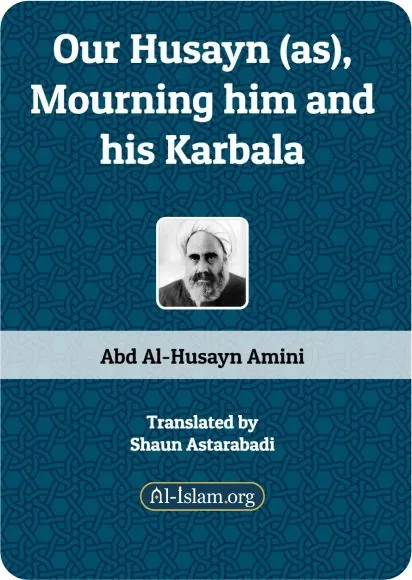
Our Husayn Mourning Him and His Karbala
Author unattributed
- Language
- English
- Pages
- 14
- PDF size
- 634 KB
About this book
It is accepted to the Islamic nation, due to the finality of the prophethood and its particular concerns, that the Holy Prophet (S) had the knowledge about the wars, trials and that which happened to his family-house hold, their progeny, and relatives, more or less, of the enormous tragedies, of the dark surprises of time, of the hard events, wide killings, and to whatever else that has entered on them from torture, trickery, ill-treatment, capture and imprisonment.
This knowledge of his (S) is from among the wide, unconditional, and fully general (master) leadership on every creation. As not acting on this information, using it for forgiveness and patience (instead), as if nothing was going to occur, all while he could have taken these men without any consequence.
These unjust men of tyranny, men of corruption, he (S) (could have taken them) using his knowledge of that he knew of them. To uphold legal punishment before they attack, punish before the crime, to sever the ties with the offending clan, not to have good relation with the aggressors; and to send away those whom he knew of aggression bad fortune and animosity to his family from his field, away from his person. All of this is also from the concerns of the leadership. No human, ever, can carry this heavy burden. While this knowledge and this forgiveness is not combined in any of the sons of Adam. This can not be conceived in any human except in one who has the leadership (Wilayah).
This is an important subject, very wide, form the sciences of religion, if we were to go into its details we would end up with a heavy book.
This condition caused the Messenger of Allah (S) to look to all of these events and tragedies which were to inflict his household, as long as he lived, the essence of his kidneys (Hasan & Husayn), his love and a part of himself (Fatima) and her cousin his greatest supporter in truth (Ali) and from their good progeny; as if he was viewing the events from behind a thin screen.
Whenever he looked to one of them, up close, his knowledge, as a matter of fact, would play the scenes before his eyes. Therefore, for the length of his life, he displayed his sorrow and depression among those close to him, naturally. His sorrow does not separate from him, he lived with it, crying secretly, hiding the longing and swallows the pain.
Whenever he found the appropriate environment he would attempt to cure the pain of his heart, put off the heat in his heart and the fire of sorrow by hugging one of his family close to his chest, he would smell and kiss pouring his tears, with crying eyes and his tong carries what amuses his feelings.
You would see him (S) holding on to Ali (as), the master of his progeny, his cousin and father of his “sons”, in the middle of the road he would kiss him and repeat his saying: “My father is your ransom. (You) The lonely the martyr.” As reported by Mrs. ‘Aesha, the mother of believers,
Reader reviews
A bad scan, a missing page or the wrong author? Report a problem with this book
Read next
Related works

Beyond the Karbala Paradigm Rethinking Revolution and Redemption in Twelver Shi‘a Mourning Rituals
Edith

The Road to Karbala
Travis Preston
The Lives of the Twelve (A Look at the Social and Political of the 12 Infallible Imams
Shaykh Mahdi Pishvai
Parallels between Husayn bin Ali and John the Baptist
Sayyid Muhammad Rizvi

The Journey of Tears
Mulla Bashir Hassanali Rahim

An Introduction to Popular Consience [in] Husain’s Revolution
Muhammad Mahdi Chamseddine